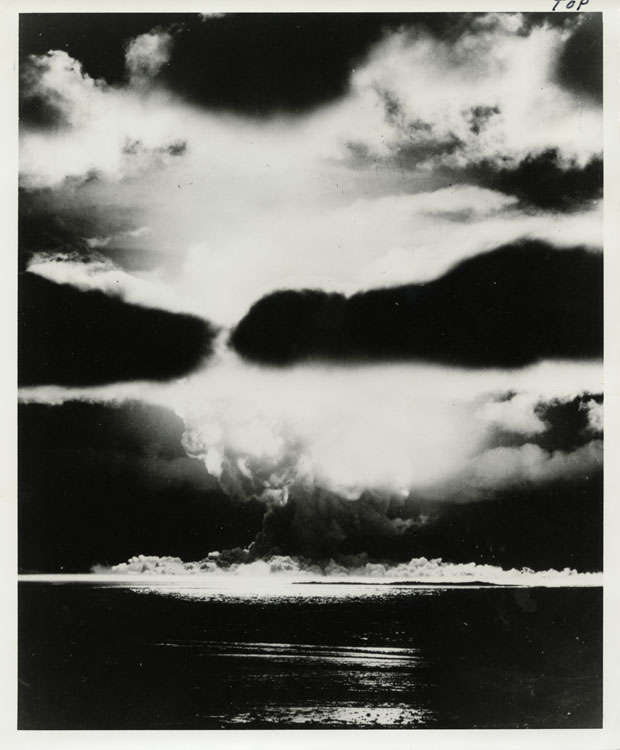
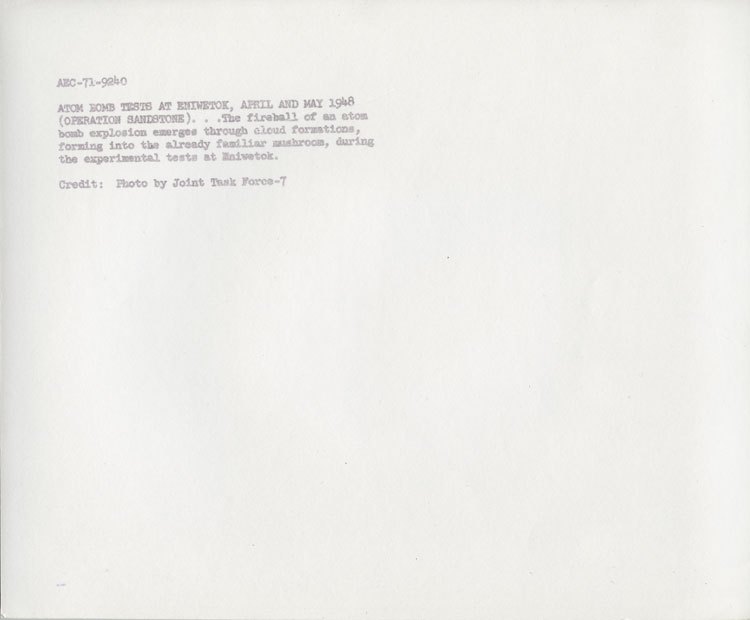
Yoke was, for three years, the largest nuclear explosion the world had seen. Detonated from a 61-metre tower on Aomon Island at Enewetak Atoll before dawn on 1 May 1948, it produced 49 kilotonnes — more than three times the Hiroshima bomb, and a record that stood until 1951. Yet for all its size it was regarded within the weapons programme as a clumsy device: it reached that yield by burning through a large quantity of enriched uranium, a wasteful way to make a big explosion.
Yoke was one of three shots in Operation Sandstone, the first American test series run by the civilian Atomic Energy Commission, and the one that transformed the nuclear stockpile. Sandstone proved a new implosion design in which the bomb's core was suspended in a gap inside its surrounding shell, so that the imploding shell struck it like a hammer and compressed it far more efficiently than the solid-packed wartime Fat Man. The improvement was so decisive that the old design was abandoned outright; the more efficient of the Sandstone cores went straight into the stockpile, and the total explosive power of the American arsenal rose by roughly three-quarters almost overnight. Yoke held the yield record, but its more frugal sibling, X-Ray, was the design that mattered.
The island Yoke was fired from was not chosen empty. Aomon lies within Enewetak Atoll, the home of the Marshallese people of Enewetak, who months earlier had been removed from the atoll and resettled on distant Ujelang — the start of a displacement that would keep them from their homeland for decades as one test after another consumed it. Yoke was among the first of forty-three detonations the United States would set off at Enewetak over the following ten years, on ground the Marshallese had been made to leave behind.