The Strangelove Collection is an archive built by Peter Voigt, a German photographer. He documents landscapes shaped by industry, ideology and time—on assignment and in his own long-term projects, often with large-format cameras.
His work can be seen at petervoigt.com.
The collection holds several thousand original vintage prints of the atomic and space age—nuclear research and testing, the society that lived with it, rocketry and spaceflight—gathered over fifteen years and curated according to artistic rather than historical criteria.
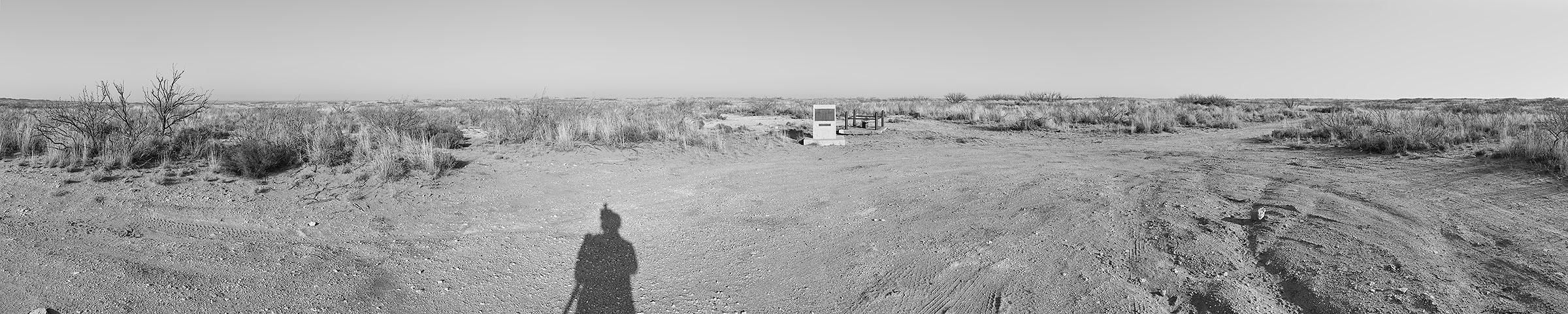
It began in Voigt’s own photography. He photographed decommissioned missiles at White Sands and in military museums across the United States, work shown in War Machines, curated by Wim Melis, at the Noorderlicht festival in Groningen. At the same festival, Bas Vroege’s Multivocal Histories presented photographers combining their own images with found material—an idea Voigt took up, and began collecting. The collection has since become an independent project, though the photographing has not stopped: the ground of a nuclear test site in New Mexico, Hiroshima and Nagasaki, the irradiated planks of the Daigo Fukuryū Maru in Tokyo. Two instruments, one investigation.
Voigt works as a curator and a storyteller. He selects what enters the archive, catalogues and preserves it, then groups and sequences the prints until narratives emerge that no single photograph could carry alone. Sometimes he tells the story outright. More often he constructs the sequence and shows it, and the new narrative assembles itself in the viewer—belonging to none of the original images. The material runs across every register, from the openly comic to the genuinely sinister. These are photographs of the past. They keep turning out to be about now.
The collection extends into Strangeplace, an exhibition space in Offenbach am Main. Prints from the archive are shown there, and invited artists exhibit work of their own—sometimes in dialogue with photographs from the collection. What is tested in both cases is the same boundary: where applied photography crosses into art.
On how the collection began, and what it contains, read the interview.
For researchers, curators and historians, the catalogued part of the collection is open as a research archive: both sides of each print, transcribed captions, dates and credits. Access is by individual registration. Request access or log in.
