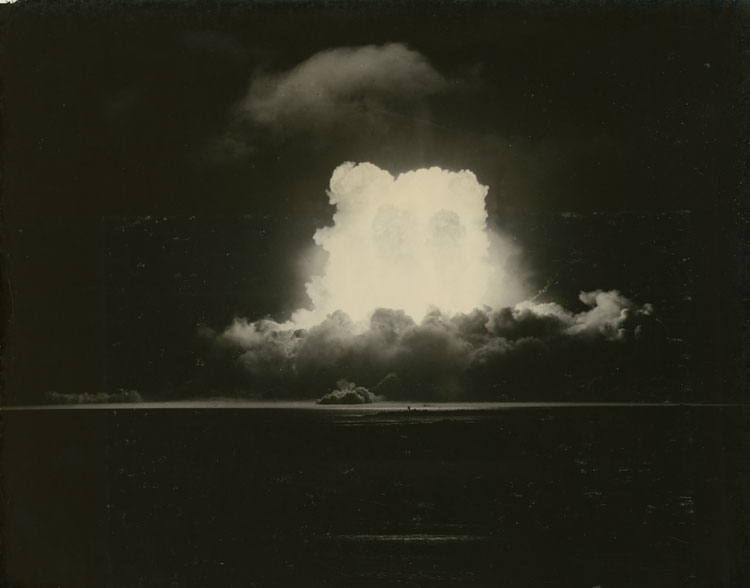
Shot Zebra was the third and final nuclear detonation of Operation Sandstone, fired on 15 May 1948 from a 61-metre tower on Runit Island, Enewetak Atoll, producing 18 kilotons. Operation Sandstone was the first American nuclear test series since Operation Crossroads in 1946 — authorised by President Truman on 27 June 1947, conducted by Joint Task Force Seven with 10,200 personnel, and kept from public view behind a veil of deliberate vagueness. Its purpose was to test the first generation of new weapon designs since the wartime Fat Man bomb: all three Sandstone devices used a levitated core — a gap between the fissile core and the tamper that created more efficient compression on implosion — replacing the conservative solid-core design of Hiroshima and Nagasaki. Zebra used an all-oralloy core of highly enriched uranium. Despite producing a lower yield than the preceding Yoke shot, it demonstrated superior efficiency for its core size. The Sandstone results led immediately to the stockpiling of both the X-Ray and Zebra core designs, replacing all earlier types. Taken together, this produced an immediate 75% increase in the total explosive yield of the American nuclear stockpile — achieved not by building more weapons, but by making each one more destructive.