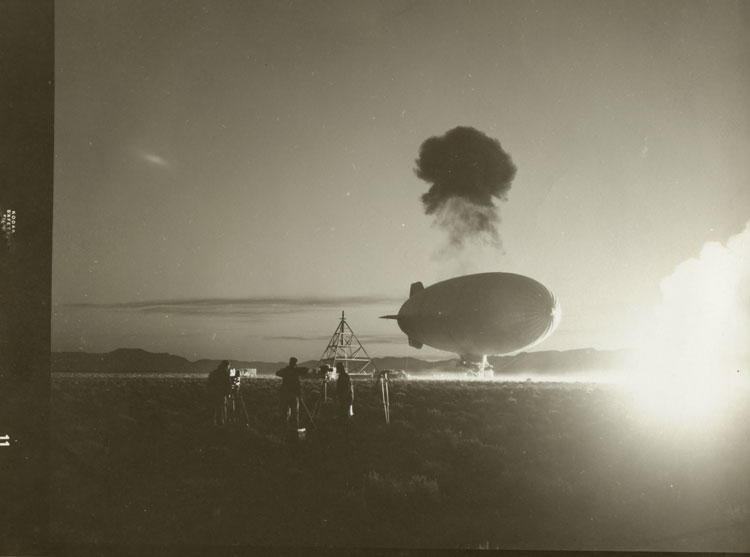
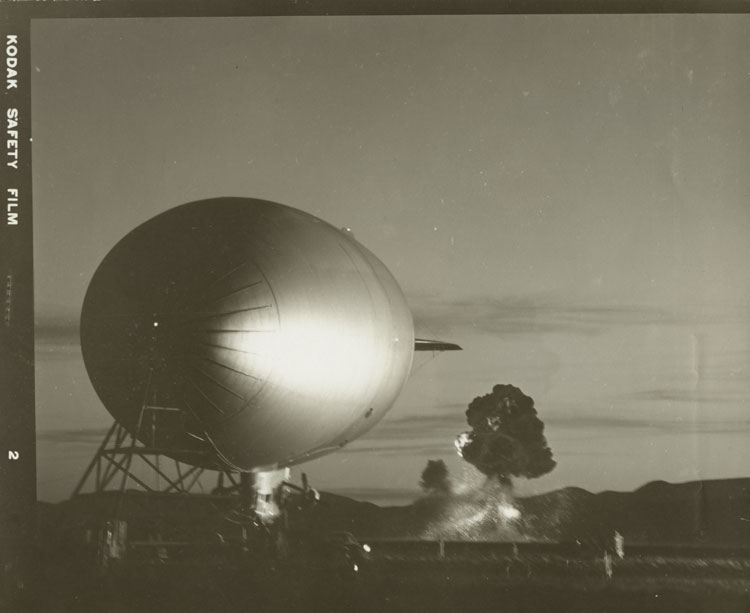
Franklin was a failed warhead test that doubled as an experiment on airships. Detonated from a 91-metre tower at the Nevada Test Site on 2 June 1957, the Los Alamos device was expected to yield about two kilotonnes but produced only around 140 tonnes — some seven per cent of its prediction, a clear fizzle. The warhead under test, the W-30, was later reworked with more fissile material and a different explosive and fired successfully as Franklin Prime; in its finished form it would arm a naval anti-aircraft missile and a portable atomic demolition charge.
Franklin also carried a stranger purpose. Tethered near the shot was a United States Navy blimp — one of four airships the Navy exposed to nuclear blasts across Operation Plumbbob to find out whether a crew could drop a nuclear depth charge on a submarine and fly clear before the shock wave overtook them. At Franklin the airship was moored tail-on to the blast and met only a low overpressure, milder still because the device fizzled; it held. Months later, at the shot Stokes, a free-flying blimp about eight kilometres from a full-yield detonation was crushed by the shock wave and deflated — in effect the answer to the question Franklin had begun to ask.
Franklin belonged to Operation Plumbbob, the sprawling 1957 Nevada series that staged the largest troop exercises in the history of American testing and, across its twenty-nine shots, put more radioiodine into the air than any other continental series — fallout later estimated to have caused thousands of thyroid cancers among the population downwind. Franklin's own share of that was slight. It was one of the smallest shots of the series, remembered less for what it destroyed than for what it failed to do.