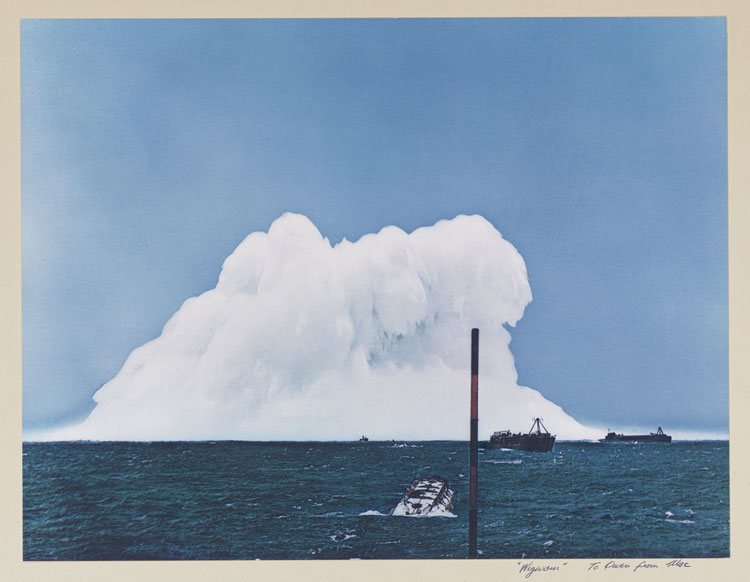
Wigwam is the only nuclear weapon the United States ever detonated in the deep ocean. On 14 May 1955, some 800 kilometres southwest of San Diego, in Pacific water nearly five kilometres deep, a 30-kilotonne bomb was lowered 610 metres beneath a barge and fired. It was not a weapons test in the usual sense but an experiment in killing submarines: the Navy wanted to know how close a nuclear depth charge had to go off to destroy a submerged submarine, and whether such a weapon could be used without also destroying the ships and crews that delivered it.
To find out, three unmanned miniature submarine hulls — nicknamed "Squaws," packed with cameras and instruments — were suspended at depth at measured distances from the bomb. The nearest, about a mile and a half away, was crushed and sank within seconds; another survived the detonation only to founder on the way back to port. The lesson was that the killing agent was not fire or blast but the shock wave rolling out through the water, and that a single nuclear depth charge could destroy a submarine well over two kilometres away. At the surface the explosion showed only as a vast dome of spray, with no mushroom cloud — the force was spent against the sea.
Wigwam was carried out almost entirely in secret, far out of public sight, and it treated the men who ran it as part of the experiment: Navy personnel aboard the fleet were among the human subjects whose radiation exposure the test set out to measure. The Atomic Energy Commission prepared, in advance, a plan to reassure the public and shield the California tuna industry should the blast raise fears of contaminated fish. The health consequences for the participants did not reach public attention until 1980 — a quarter of a century later — when a magazine account of sick veterans began forcing open records that had stayed classified.