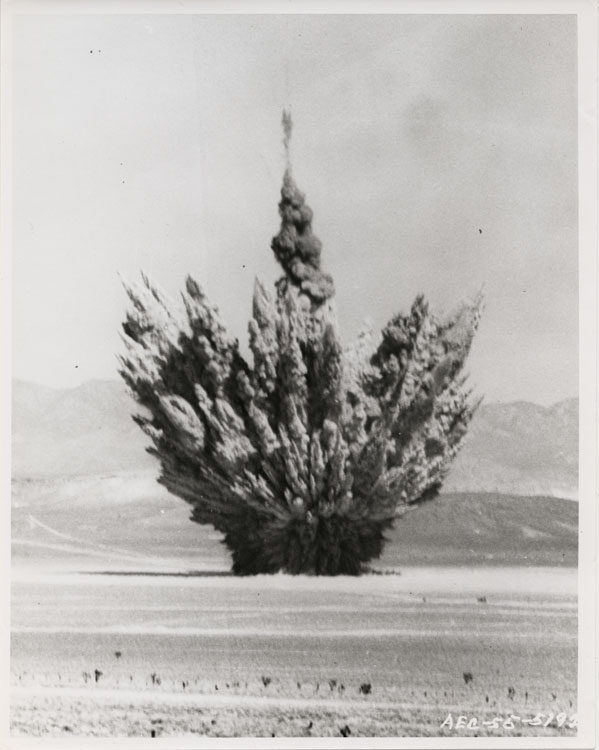
Ess was a test of the nuclear bomb as a demolition tool — in effect, a nuclear landmine. On 23 March 1955 at the Nevada Test Site, a device of about 1.2 kilotonnes was lowered into a steel-lined shaft, buried some 20 metres beneath the desert of Yucca Flat, packed over with sandbags and earth, and fired. The explosion heaved thousands of tonnes of ground into the sky and left a crater roughly 90 metres wide and nearly 40 metres deep. Its name, short for "Effects, Sub-Surface," states the purpose plainly: this was an operational test of an "atomic demolition munition" — a nuclear charge meant to be buried and set off to crater terrain and block an advancing army.
Ess was the only buried shot of Operation Teapot, the 1955 Nevada series built largely around training soldiers for nuclear war. Roughly 800 troops took part in the exercise at this shot, some 350 of them watching from the open desert about eight kilometres away, and one of the exercise's projects had soldiers emplace and test the demolition charge themselves. The concept they were rehearsing — burying nuclear weapons to drop bridges, collapse mountain passes, and crater roads in an enemy's path — became real hardware: the United States went on to field portable atomic demolition munitions, including one light enough to be carried and set by a small team, and kept them in Europe into the 1980s.
The shot left a longer trace than its small yield suggests. Because it was buried, Ess gave scientists an early, close reading of what a nuclear explosion does underground, and the understanding it produced has scarcely changed since — knowledge that fed directly into the decisions behind the 1963 Limited Test Ban Treaty, the agreement that would soon drive all testing beneath the surface.