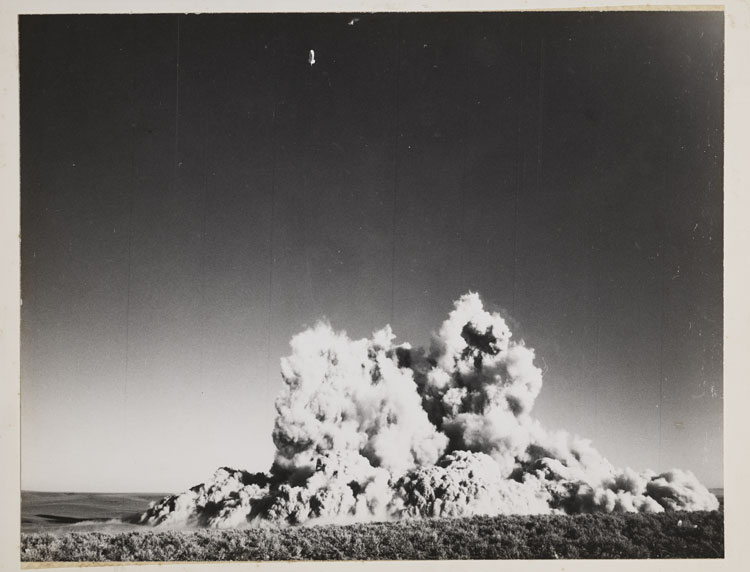
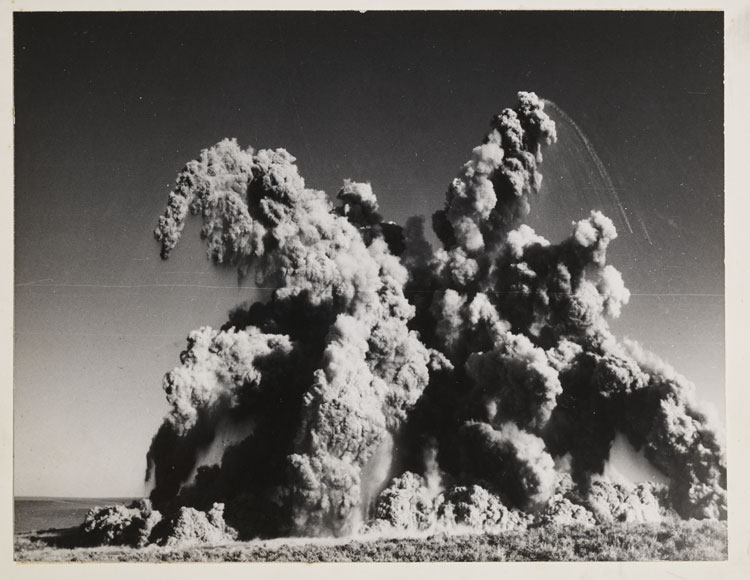
Double Tracks was not a nuclear explosion but a rehearsal for a nuclear accident. On 15 May 1963, on open ground at Stonewall Flat in the Nevada desert, the conventional high explosive of a plutonium weapon was detonated deliberately — with no nuclear yield — to learn what happens when such a weapon is wrecked in a crash or fire rather than fired. It was the first shot of Operation Roller Coaster, a joint United States and British programme of four such trials, run to measure how the plutonium from a broken weapon would scatter and how far its contamination would travel.
The blast threw on the order of a kilogram of plutonium into the air as a fine aerosol, which drifted downwind across the desert. Teams tracked and sampled the cloud to measure the size and spread of the particles, and animals were placed in its path to gauge what breathing it would do to living tissue. Double Tracks was an open, unbunkered shot; other tests in the series were fired inside earth-covered storage bunkers to see whether such structures could hold the contamination in.
The plutonium it scattered does not decay on any human timescale, and the ground stayed contaminated for decades. Only in the 1990s did remediation begin: the most heavily contaminated soil at the Double Tracks site was excavated and hauled to the Area 3 Radioactive Waste Management Site inside the Nevada Test Site for disposal, and the ground was reseeded — an attempt to return a patch of poisoned desert to something like neutral, more than thirty years after a single deliberate explosion had salted it.