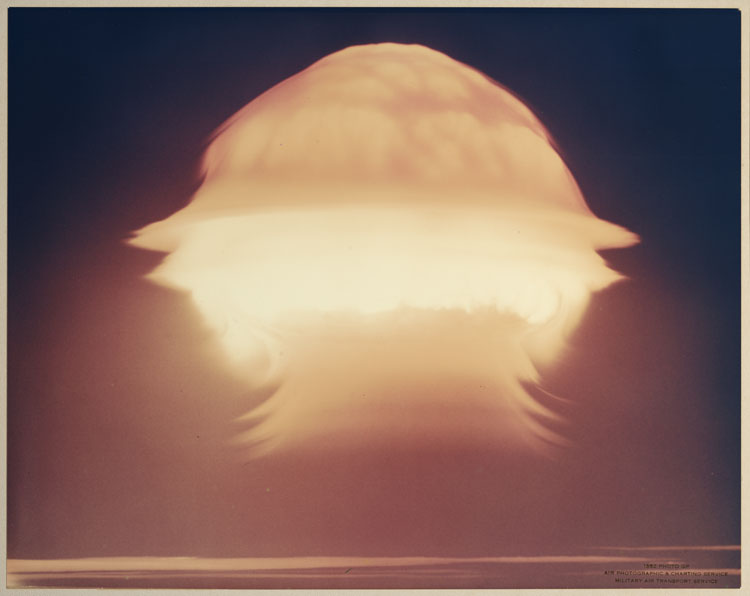
Chama was a hydrogen bomb detonated in the most dangerous days of the twentieth century. On 18 October 1962, as President Kennedy and his advisers secretly weighed military action against the Soviet missiles discovered in Cuba, a B-52 dropped this 1.59-megatonne device over the Pacific near Johnston Island, where it burst at about 3,650 metres. The Cuban Missile Crisis was days from its most perilous point, yet the United States' Pacific test series ran on undisturbed — scheduled megatonne detonations continuing on bureaucratic autopilot even as the two superpowers edged toward nuclear war.
Chama was a Los Alamos weapons-development shot, one of dozens crammed into Operation Dominic, the crash series the United States launched in 1962 after the Soviet Union broke a three-year pause in testing. The device, code-named Thumbelina, was an experiment in miniaturisation: a lightweight, small-diameter design carrying more than a hundred times the Hiroshima yield, meant as a possible replacement for an existing intercontinental-missile warhead. On the day, it fell short of its predicted yield.
The timing was not peculiar to Chama. Through the crisis, the American and Soviet programmes both kept firing on schedule — nine days later, on the single most dangerous day of the confrontation, the United States airburst an 800-kilotonne bomb over Johnston Island while the Soviets detonated one of their own at Novaya Zemlya, neither leadership pausing to note it. Dominic was the last and largest atmospheric series the United States would conduct; within a year the 1963 Partial Test Ban Treaty ended open-air testing. Chama is a small, routine entry in that record — a megatonne explosion so ordinary, by 1962, that it passed almost unremarked amid the week the world came closest to ending.