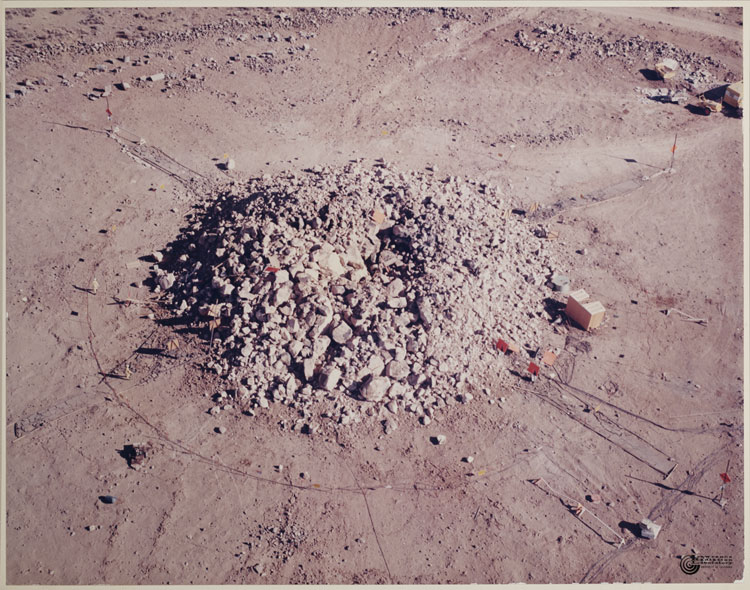
Sulky is the only nuclear explosion in American history that raised a hill instead of digging a hole. Detonated on 18 December 1964, buried about 27 metres deep in the hard basalt of Buckboard Mesa at the Nevada Test Site, the small device — some 85 tonnes of TNT equivalent — was meant to blow out a crater. Instead it heaved up a permanent mound of shattered rock roughly 24 metres across and 6 metres high. The result was named a "retarc" — "crater" spelled backwards, an upside-down crater — and Sulky remains the only one the United States ever produced.
The experiment belonged to Project Plowshare, the programme to turn nuclear explosives into civil-engineering tools, digging canals and harbours or cutting highways through mountains. Sulky was fired to learn how a nuclear blast craters hard, dry rock, at a burial depth set deliberately too deep to throw out a clean crater. The rock then did something its designers had not expected: broken into blocks, it swelled to about three times its original volume, and being strong enough not to settle back, it simply stood up as a mound. The measurements taken from it helped map the outer limits of nuclear excavation in stone.
Sulky was one of a long line of Plowshare cratering shots meant to prove nuclear excavation practical, which instead helped prove it was not. Each put radioactivity into the air or across the ground, and mounting public alarm over the fallout — together with the absence of any project worth the risk — ended the programme in the 1970s. No canal or harbour was ever dug this way. What Sulky left is a small contaminated hill in the desert, a monument to an abandoned idea.