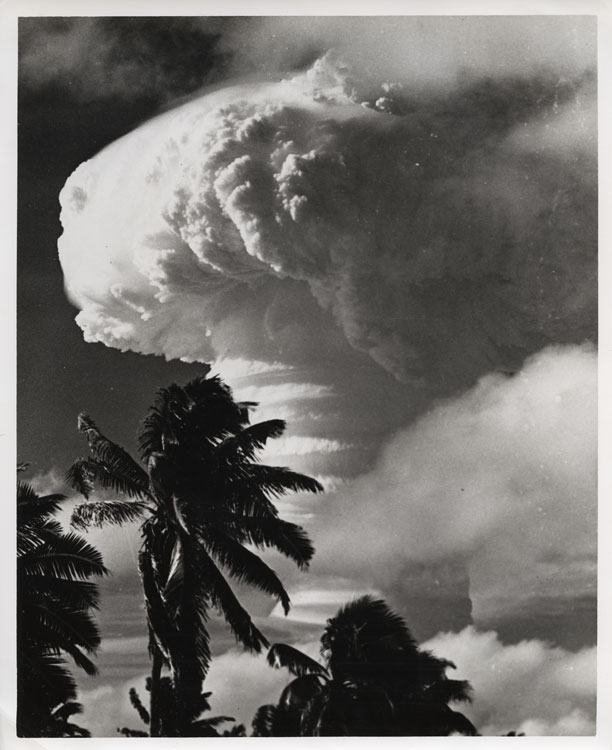
Arkansas proved the warhead that would arm the Minuteman missile — and it descended, for the first time in the series, beneath a parachute. Dropped from a B-52 over the Pacific near Christmas Island on 2 May 1962 and detonated at about 1,530 metres, the 1.09-megatonne shot was a Livermore test of the W-56, the warhead chosen to sit atop the Minuteman intercontinental missile. The design had a direct ancestry: it was derived from the W-47, the breakthrough warhead Livermore had built for the Polaris missile that went to sea aboard submarines. In effect, the compact weapon that armed America's underwater deterrent was reworked, lighter, into the one that would arm its buried land-based deterrent.
Arkansas was the first Christmas Island shot to use a parachute to slow its fall — a technique that let the bomber climb clear of a very large explosion and gave the instruments below a cleaner, better-positioned burst to measure. The test also showed how far the design had been squeezed: the W-56 carried roughly the same yield as its Polaris predecessor while shedding weight, reaching a ratio of explosive power to mass close to the practical limit of what such a device can achieve. That efficiency was the whole point — every kilogram saved was a kilogram a missile could spend on range or accuracy.
The warhead Arkansas helped prove became one of the mainstays of the American deterrent. Around a thousand W-56s were built for the Minuteman I and II, and some remained on alert in their silos into the 1990s. Arkansas itself was one of the first shots of Operation Dominic, the crash series the United States rushed into the Pacific in 1962 — an effort worked through, at a punishing pace, by tens of thousands of servicemen, many of whom would later be recognised as radiation-exposed veterans, eligible for compensation for the illnesses that followed.