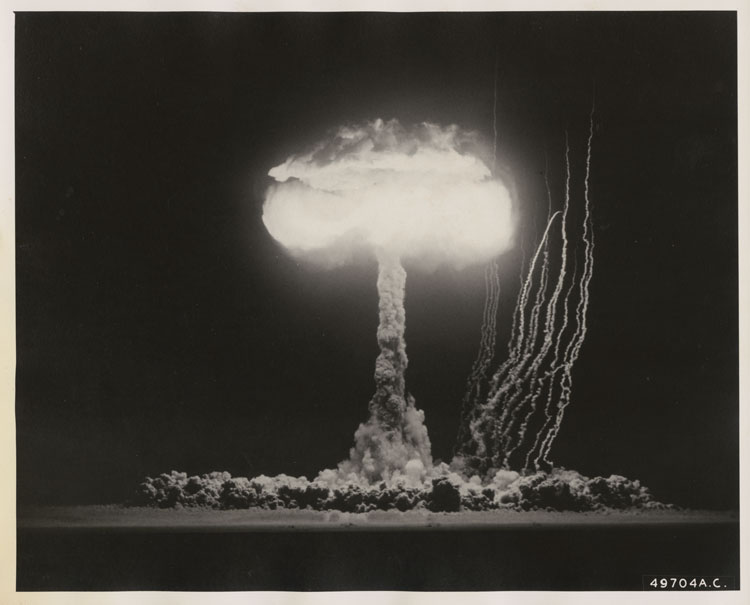
Climax was the largest nuclear explosion the United States had yet detonated on the American mainland, and it was also a fuse for far larger ones to come. Dropped from a B-36 bomber over Yucca Flat at the Nevada Test Site on 4 June 1953 and detonated at about 410 metres, it produced 61 kilotonnes — the highest yield of any continental American test to that date, and the closing shot of Operation Upshot-Knothole. The device was a proof test of the Mark 7, the lightest and most compact fission bomb the country had built, small enough to hang beneath a fighter-bomber.
What made Climax matter beyond its size was what its bomb would become. The Mark 7 was a boosted fission device, and its compact core was being proven not only as a weapon in its own right but as a primary — the fission trigger that ignites the fusion fuel in a hydrogen bomb. Climax confirmed it worked: a follow-up test series meant to settle that question was cancelled as unnecessary, and this same primary went on, the next year, to trigger the thermonuclear shots of Operation Castle — among them Castle Bravo, the largest weapon the United States ever detonated. The small fission bomb tested here was, in effect, the spark for the megatonne age.
Climax also closed a series whose deeper legacy was measured downwind. Operation Upshot-Knothole put some 35,000 kilocuries of radioiodine into the air — more than ten times the amount released by the Trinity test — and its fallout drifted across the inhabited country of southern Nevada and Utah. The National Cancer Institute later estimated the series exposed the American public to enough radiation to cause on the order of 28,000 thyroid cancers. The towns downwind of the Nevada site, dusted again and again through the spring of 1953, would spend the decades that followed seeking acknowledgement, and compensation, for the cancers that came.