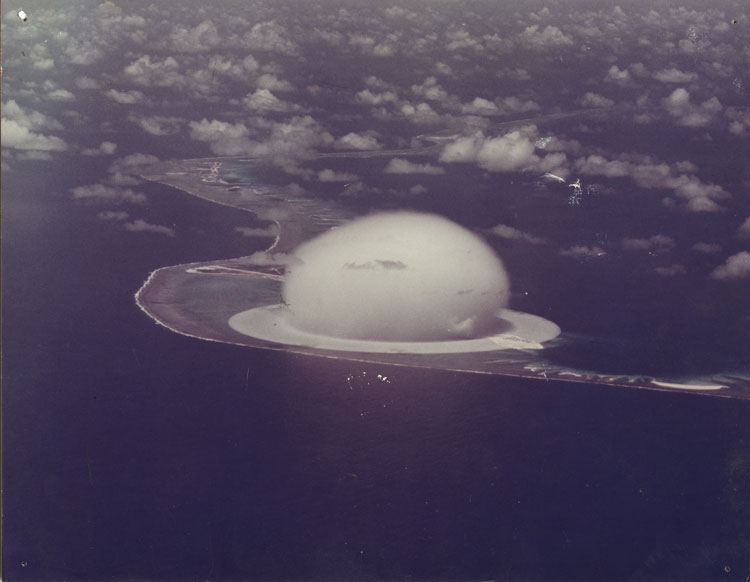
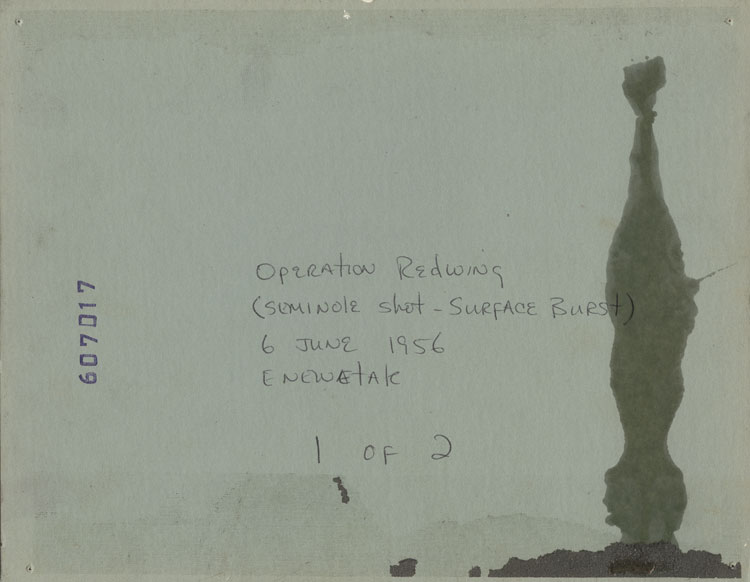
Seminole was one of the strangest nuclear tests the United States ever conducted: a bomb detonated inside a tank of water. Fired on Bogon Island at Enewetak Atoll on 6 June 1956, the 13.7-kilotonne device sat in a sealed chamber inside a huge water-filled tank, reached by a corridor running in through the water. The purpose of the water was to press the explosion's shock wave down into the ground — in effect, to make an above-ground shot behave like a buried one, and to study the cratering and coupling that a nuclear weapon produces against the earth. It worked: the blast tore a crater about 200 metres wide and 10 metres deep, lopsided because the chamber had been set off-centre within the tank.
The shot was engineered to catch a precise moment. It was timed so that as the fireball reached the tank wall, it was passing from the first phase of a nuclear explosion — growth driven by radiant heat — into the second, driven by the shock wave itself, so that the expanding front was still fiercely luminous as it burst through the water. The device at its heart was a boosted primary for the developing TX-28 weapon, tested here both to prove the design and to serve as the source for the effects experiment around it.
Seminole belonged to Operation Redwing, the 1956 Pacific series fired on the atolls of the Marshall Islands. The people of Enewetak, on whose atoll Bogon lies, had been removed nearly a decade earlier so their homeland could be used as a proving ground, and they were still in exile as shots like this one reshaped the islands they had left. Redwing's seventeen detonations, Seminole among them, added to the radioactive burden the Marshallese would carry long after the tests had ended.