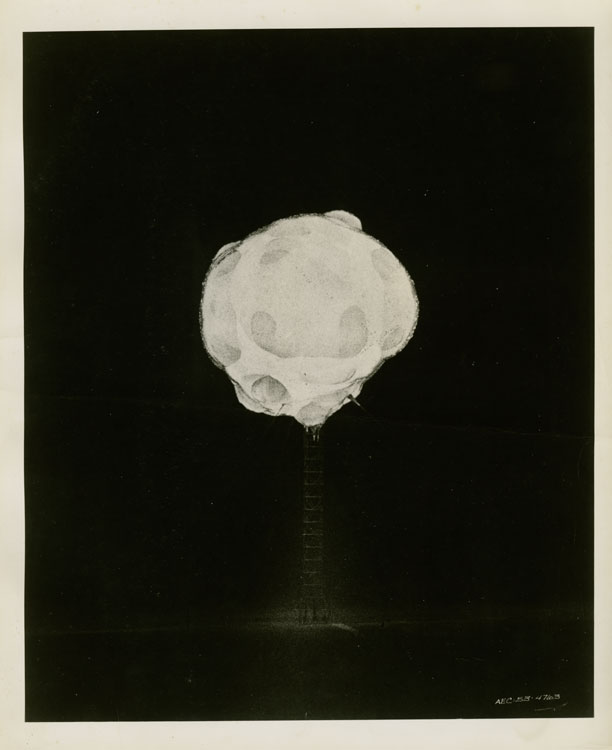
Shot Harry was the eighth nuclear detonation of Operation Upshot-Knothole, fired on 19 May 1953 from a 91-metre tower at Area 3 of the Nevada Proving Ground. The device — codenamed Hamlet — was a heavyweight strategic bomb design developed by Ted Taylor at Los Alamos, notable for an unusually efficient hollow core implosion system. It produced 32 kilotons against a predicted yield of 37 kt. Shot Harry became the most contaminating nuclear test in American continental history for civilian downwinders: of an estimated 85,000 person-roentgens of cumulative external gamma ray exposure from all Nevada tests through 1958, Harry alone accounted for 30,000. This photograph was taken with a Rapatronic camera — a device developed by MIT electrical engineering professor Harold "Doc" Edgerton and his colleague Charles Wyckoff through their firm EG&G (Edgerton, Germeshausen & Grier) under contract to the Atomic Energy Commission. The Rapatronic camera used a magneto-optical shutter with exposure times measured in tens of nanoseconds, triggered automatically by the initial flash of a nuclear detonation, with no mechanical moving parts. In order to create time sequences, banks of four to ten cameras were deployed, each capable of recording only a single exposure, carefully timed to record successive fractions of a second. The cameras operated from approximately 11 kilometres from the detonation point.