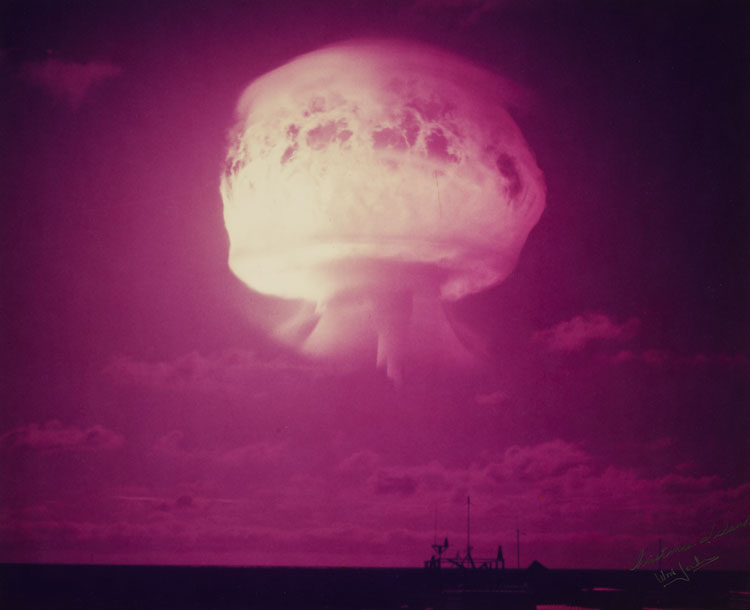
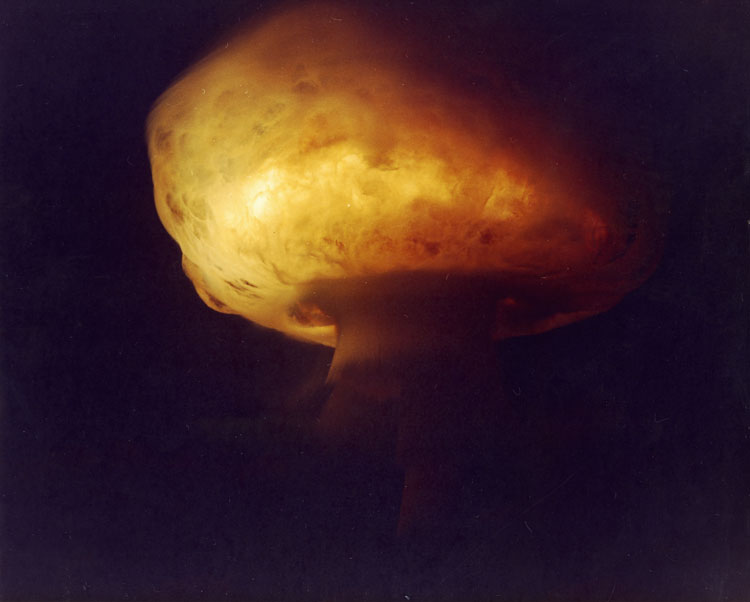
Bighorn was one of the most powerful detonations in the United States' frantic return to atmospheric testing in 1962. After three years in which both superpowers had voluntarily held off, the Soviet Union resumed testing in September 1961 — ending with the largest bomb ever exploded — and the United States answered with Operation Dominic, the biggest and most hurried atmospheric series it ever ran, compressed into roughly a third of the usual time. Bighorn was a hydrogen bomb of 7.65 megatonnes, more than five hundred times the force of the Hiroshima weapon, dropped from a B-52 to burst about 3,600 metres above the ocean some 48 kilometres south of Christmas Island.
Its purpose was efficiency rather than sheer size. Bighorn tested an advanced design from the Livermore laboratory — by then renamed the Lawrence Radiation Laboratory — built to wring the greatest possible thermonuclear yield from the least weight, the property that decided whether a warhead of such power could be carried by a missile. At about 4.14 kilotonnes per kilogram it was a strong result, and the second most powerful shot of the entire Dominic series.
The Dominic airdrops were burst high over open water, so their fallout fell largely on the Pacific rather than on land. But Christmas Island, the British possession used to stage the tests, was not empty: British and Commonwealth servicemen were stationed there throughout 1962, many of whom would later seek recognition for illnesses they linked to radiation exposure. Dominic was the closing chapter of American atmospheric testing — within a year the 1963 Partial Test Ban Treaty drove all United States nuclear tests underground.