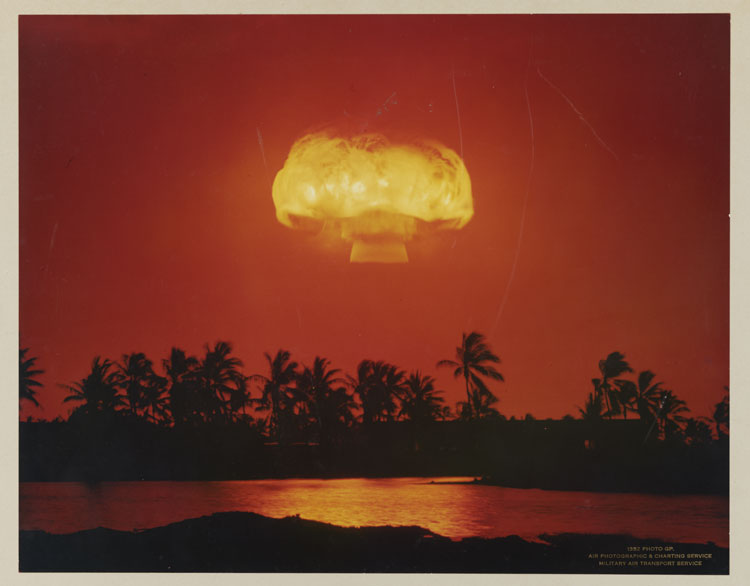
Bluestone helped prove the warhead that would form the backbone of the American nuclear deterrent for the next thirty years. Detonated as a B-52 airdrop over the Pacific near Christmas Island on 30 June 1962, it was a 1.27-megatonne test of the W-56, a Livermore-designed warhead competing to arm the Minuteman intercontinental ballistic missile. Unlike its Los Alamos rival, the W-59, the W-56 won that competition decisively: around a thousand were built for the Minuteman I and Minuteman II, and some stayed on alert in their silos into the 1990s.
Bluestone was one of dozens of shots in Operation Dominic, the crash series the United States ran in 1962 after the Soviet Union broke a three-year pause in testing. Many, like this one, were warhead-proving trials — validating compact, powerful designs worked out on paper during the moratorium and, in some cases, already loaded into missiles without ever being fired at full scale. The W-56 was among the most consequential: a 1.2-megatonne warhead light enough to ride a missile, it became the standard payload of the Minuteman force that would sit, by the hundreds, in underground silos across the American plains.
The endurance of the design is its own kind of statement. The bombs of Operation Dominic were fired in the open air, in a matter of weeks, in a scramble to keep pace with an adversary; within a year the 1963 Partial Test Ban Treaty would end atmospheric testing for good. But the warhead Bluestone proved outlived the era that made it. Fired in a two-week scramble to keep pace with the Soviets, the W-56 then sat armed atop Minuteman missiles in their silos for nearly thirty years — retired only in the early 1990s, as the Cold War itself was ending.