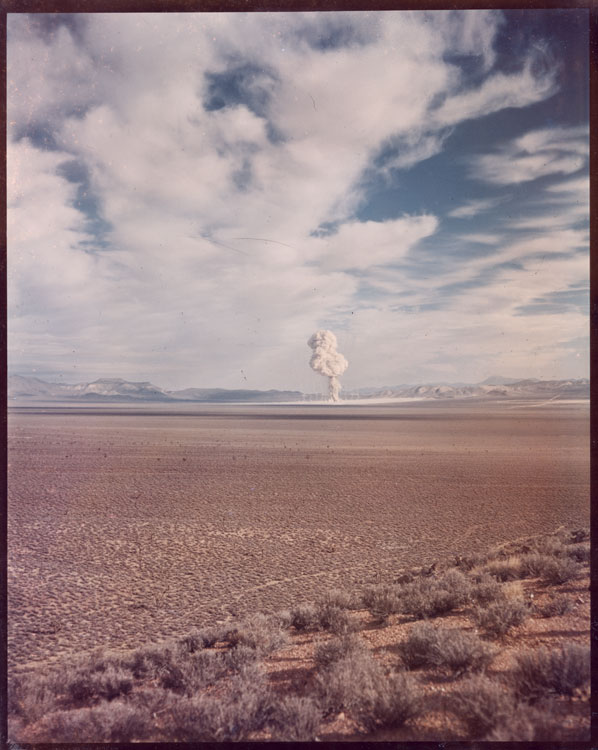
Sugar was the only true surface nuclear detonation ever fired on American soil. Where nearly every other continental test was raised on a tower, dropped from an aircraft, or buried underground, Sugar sat almost exactly at ground level — its bomb resting essentially on the desert floor of Yucca Flat — and was detonated there on 19 November 1951 with a yield of 1.2 kilotonnes. It was never repeated, and the reason it was never repeated is the reason it was fired at all: to see what a nuclear weapon does when it goes off against the ground.
A surface burst is the dirtiest kind. When the fireball touches the earth it tears up and irradiates thousands of tonnes of soil and drops it back as heavy local fallout, instead of drawing it high into a cloud. Sugar was a weapons-effects test built to measure exactly that — the cratering, the shock, and the contamination of a ground-level blast — as the United States studied low-yield weapons meant to crater airfields and wreck fortifications, and gauged how structures and equipment withstood a nuclear burst. It left a crater about 27 metres across and 6 metres deep and coated the surrounding desert in radioactivity so intense that the soldiers of the Desert Rock II exercise watched from some eight kilometres off and kept their manoeuvres well back from ground zero.
The single surface shot was enough. Its lesson — that a contact burst contaminates its surroundings far more heavily than one detonated in the air — was not one the programme cared to repeat on home ground, and later surface and cratering work was pushed out to the Pacific or driven underground. Sugar's own series, Buster-Jangle, put roughly 10,500 kilocuries of radioiodine over the country; the National Cancer Institute later estimated its fallout would cause on the order of 2,300 thyroid cancers among Americans downwind.