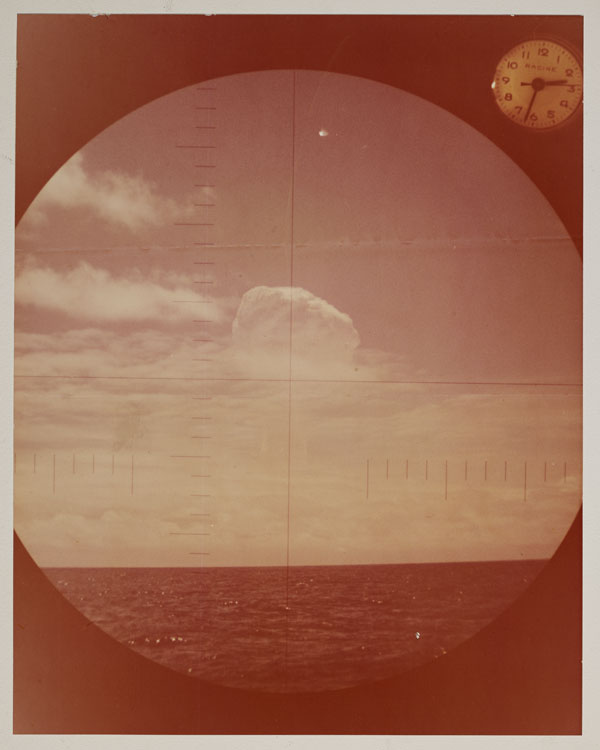
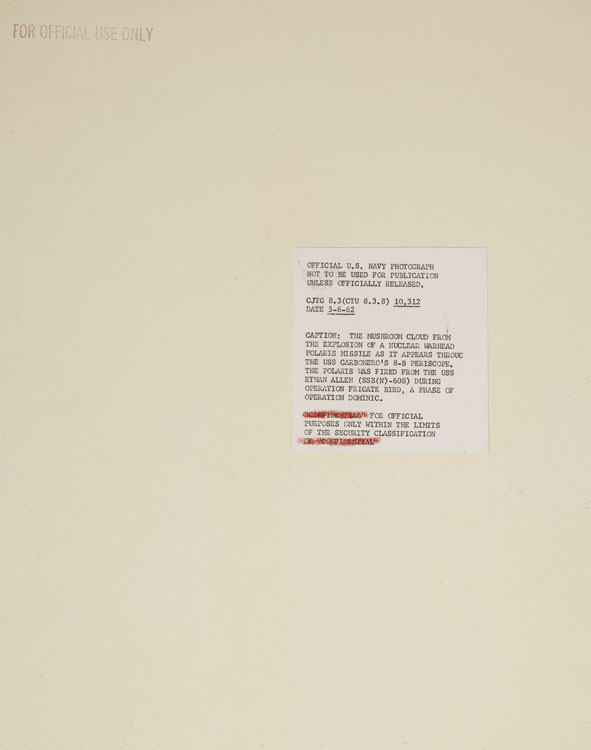
Frigate Bird was the only time the United States ever tested a complete nuclear missile from end to end — submarine launch through to nuclear detonation. Every other part of the American deterrent was proven piecemeal: warheads were exploded on towers or dropped from aircraft, while the missiles meant to carry them flew separately with inert payloads. Here, once, the whole chain was fired as one. On 6 May 1962 the submerged submarine USS Ethan Allen launched a live Polaris missile into the central Pacific; its warhead re-entered the atmosphere some twelve and a half minutes and nearly 1,900 kilometres downrange, and burst in the air at roughly 3,350 metres with a yield of 600 kilotonnes — around forty times the Hiroshima bomb.What the shot validated was the newest and most survivable part of the United States' nuclear forces: a weapon that could be launched from a hidden, moving submarine, against which there would be little warning and no defence. The detonation was watched from periscope depth by two submarines holding station within about fifty kilometres of the burst.For all that it looked like a clean success, the demonstration rested on less solid ground than it showed. The warhead type fired, the Livermore W-47, had chronic reliability problems in service — by the mid-1960s a large share of the stockpiled units were judged defective — and it later emerged that the warhead used at Frigate Bird had been modified beforehand and was not necessarily representative of those actually deployed at sea. The single triumphant proof of the system was, in that sense, not quite a proof of the weapons the submarines were carrying.