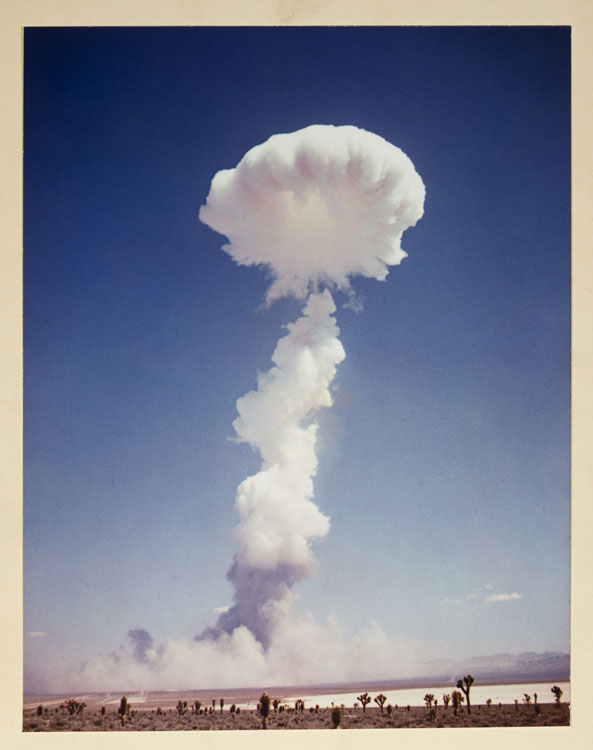
Charlie was the shot that turned nuclear testing into a show. On 22 April 1952 the United States, for the first time, invited the press to witness and broadcast a nuclear detonation on American soil: some two hundred reporters and cameramen gathered on a rocky rise about sixteen kilometres from ground zero, a spot they christened "News Nob." A Los Angeles station carried the explosion live — one of the first atomic blasts shown on television, and the one that brought the bomb into American living rooms. The 31-kilotonne device, roughly twice the Hiroshima yield and among the largest yet fired in Nevada, was dropped from a B-50 bomber and burst about 1,050 metres above Yucca Flat.
The broadcast did what it was designed to do. It made the bomb a spectacle rather than a secret and set off a wave of "atomic culture": Las Vegas, a hundred kilometres away, sold atomic cocktails and threw dawn "bomb parties," the chamber of commerce printed detonation timetables for tourists, and the mushroom cloud became a marketing emblem. Nuclear testing was recast, deliberately, as a national attraction.
Beneath the same cloud, the event was something other than entertainment. Charlie was the first major shot of Exercise Desert Rock IV: after the flash, around 1,675 soldiers advanced across the desert toward ground zero, rehearsing combat on land the bomb had just contaminated, while several hundred more watched from trenches. The series Charlie opened was among the most fallout-heavy of the continental programme — its later shot George is often cited as having exposed more Americans to radiation than any other single test. The picture beamed into living rooms was the reassuring half of something whose other half was counted, decades afterward, in the illnesses of the soldiers who stood beneath these clouds and the civilians downwind.