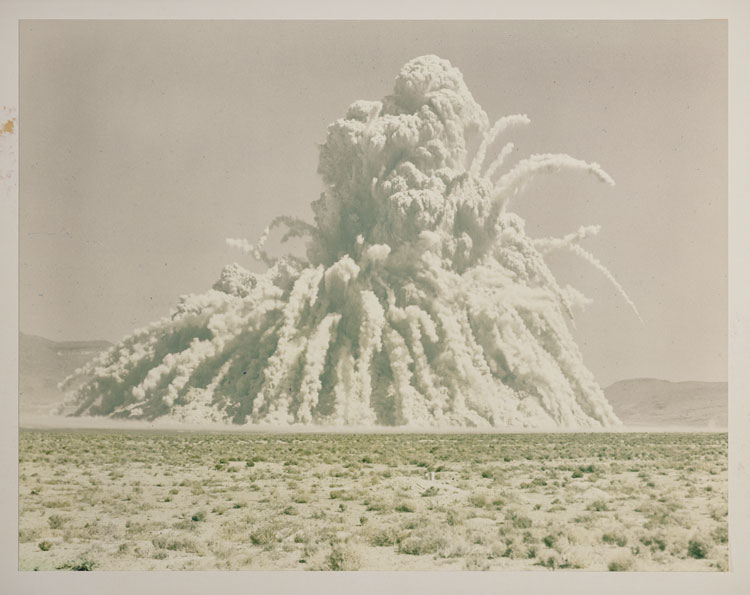
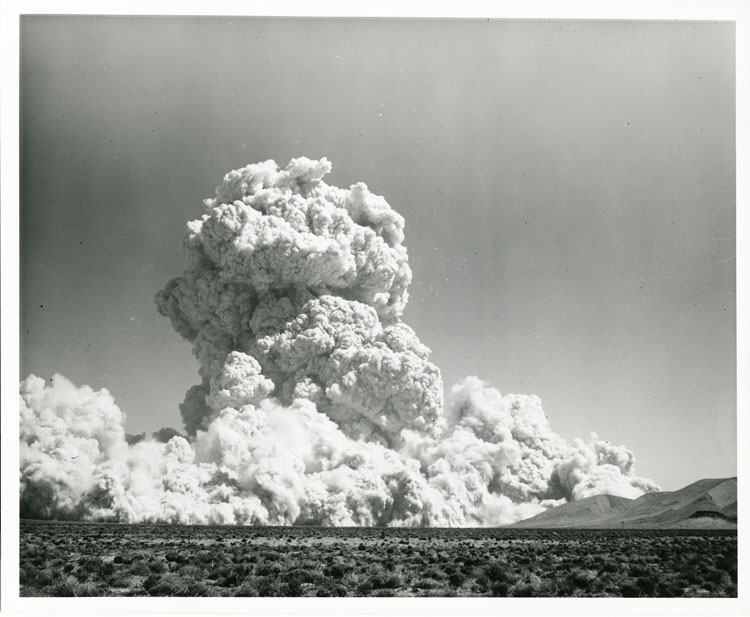
Sedan was the largest crater ever blown in the United States by a nuclear weapon — and it was meant to be useful. Detonated on 6 July 1962 beneath the desert of Yucca Flat at the Nevada Test Site, the device was buried 194 metres down and fired with a force of 104 kilotonnes. Three seconds later the ground itself rose: a dome of earth lifted some 90 metres into the air before it tore open, hurling around 11 million tonnes of rock and soil upward and outward. What was left is the Sedan Crater — about 390 metres across and 100 metres deep, still the largest human-made crater in the country. The shock registered as a magnitude-4.75 earthquake, and a wall of debris rolled outward across some eight kilometres of desert like the base surge of a volcano.
The point of all this was construction. Sedan was the flagship shot of Project Plowshare, the programme that proposed turning nuclear explosives into civil-engineering tools — to dig canals, carve harbours, open mines in an afternoon. The device, a Livermore design drawing about 70 per cent of its energy from fusion, was buried at the depth calculated to throw up the biggest possible crater: a live demonstration that one bomb could excavate what would otherwise take years. As a feat of earth-moving, it worked spectacularly.
As a peaceful technology, it did the opposite of reassure. Because the explosion broke the surface, it threw vast quantities of irradiated soil into the sky; the dust climbed to nearly 3,700 metres and split into two clouds that drifted north-east and east across the United States, toward the Mississippi and beyond. Sedan is estimated to have exposed more Americans to fallout than any other single test fired on the continent. The proof that a nuclear explosive could dig a canal was also the proof of why one never would — and public alarm over shots like this one helped bring Plowshare to its end.