Neptune was a nuclear safety test that failed at the very thing it was meant to prove. Its purpose was to confirm that the primary — the fission trigger — of the W-47 warhead, the weapon then being deployed aboard Polaris missile submarines, could not produce a nuclear explosion if its conventional explosives were set off by accident. Fired inside a tunnel driven into the slope of Rainier Mesa at the Nevada Test Site on 14 October 1958, the device instead produced a nuclear yield of about 115 tonnes of TNT equivalent — over ten times the upper limit of its prediction, and a demonstration that the design was not safe.
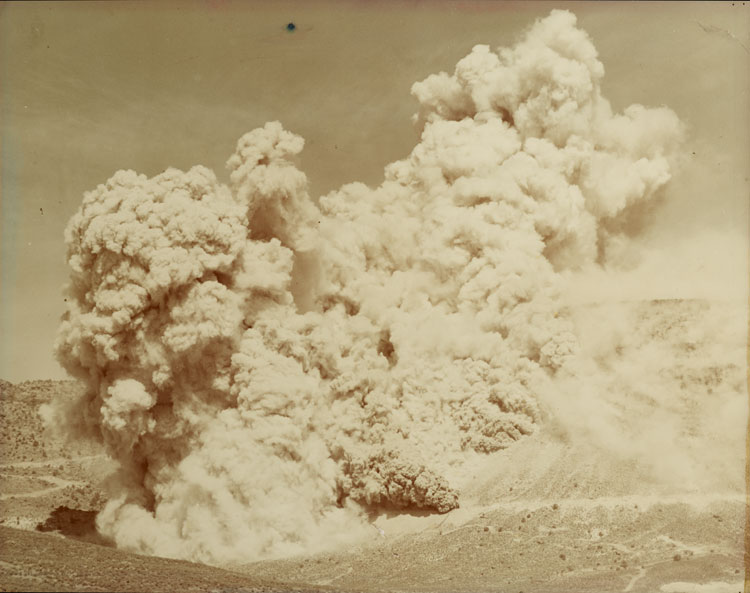
Because the charge sat only about 34 metres inside the mesa, that unforeseen energy broke out rather than staying contained. The explosion ruptured the mountainside and vented violently into the open, throwing up an enormous cloud of shattered rock and dust and leaving a crater gouged into the slope. The event was afterwards described as a "cratering experiment" — a containment failure recast, after the fact, as a deliberate study.
Neptune belonged to Hardtack II, the series rushed through before the 1958 testing moratorium, at the moment American testing was moving underground — in part to bury the fallout that had grown into an international scandal. It stands as a record of how poorly that containment worked at first: an underground shot that did not stay underground.