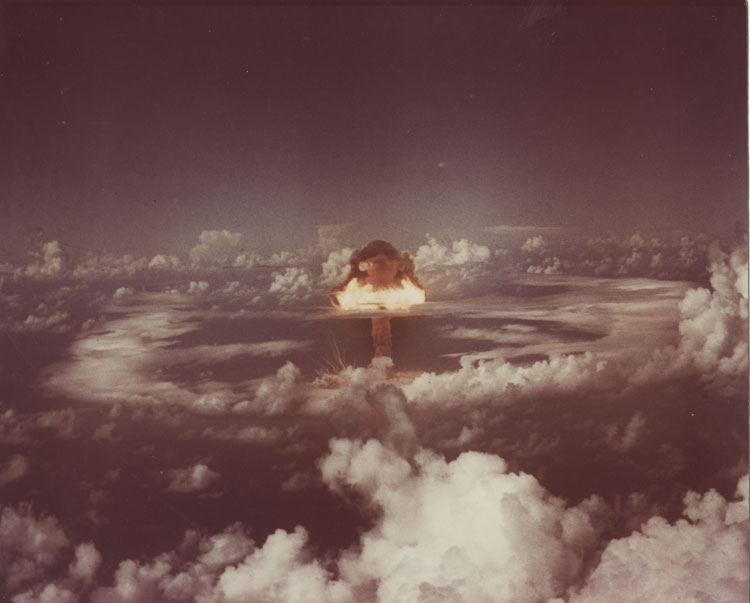
King remains, to this day, the largest fission explosion ever detonated without help from fusion. Dropped from a B-36 bomber over Enewetak Atoll on 16 November 1952 and airburst at about 450 metres, the device produced 500 kilotonnes — roughly thirty-three times the Hiroshima bomb — using only the splitting of uranium, none of the thermonuclear boost that would soon become standard. It has held that record for over seventy years, and given how the weapons programme evolved afterward, it is likely to hold it permanently: no one has built a pure-fission device this large since, because every design that followed simply added fusion instead.
King was a hedge, built in case the far riskier bet failed. It was the second shot of Operation Ivy, fired two weeks after Ivy Mike — the world's first true hydrogen bomb, an experimental device the size of a small building that could never have been carried by an aircraft. King's designers, working under the physicist Ted Taylor at Los Alamos, built it as insurance: if fusion could not be made to work, a bomb that could actually be dropped and still approach a hydrogen weapon's power. It very nearly used up fission itself as a strategy — the device packed more than sixty kilograms of highly enriched uranium into its core, over four times the mass needed to sustain a chain reaction, right at the edge of what a weapon could hold without detonating by accident. Chains of aluminium and boron were threaded through the core specifically to soak up stray neutrons and stop it collapsing into criticality on its own; they were pulled free only in the instant before the bomb was released.
Unlike Mike's one-off laboratory device, King's design was built to be carried and stockpiled, and ninety of the finished bombs were manufactured. But the world it was built for barely lasted. Within two years the compact, far more powerful thermonuclear weapons that Mike had proven possible made a five-tonne pure-fission giant like this one obsolete, and King's true legacy is the boundary it marked rather than the arsenal it briefly joined: the edge of what fission alone could ever do.