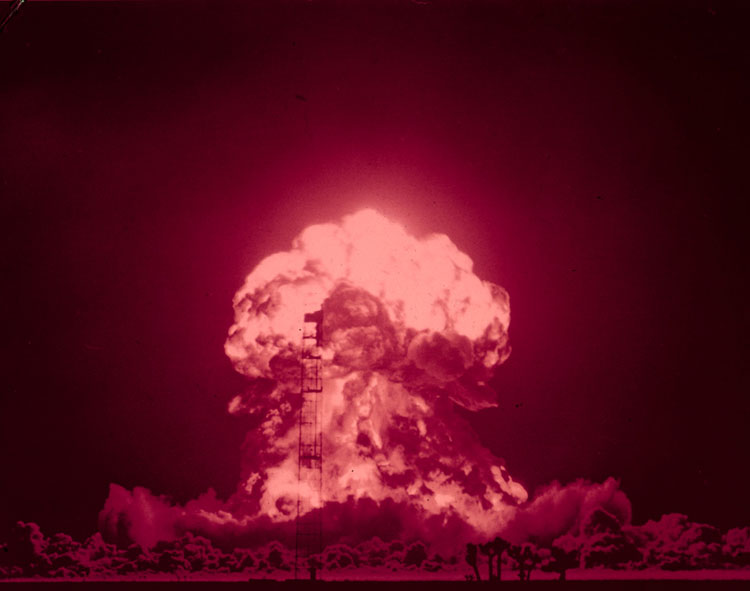
Badger tested a scaled-down piece of the first hydrogen bomb, in service of a design the United States would briefly field without ever actually firing it at full size. Detonated from a 91-metre tower at the Nevada Test Site on 18 April 1953, the shot produced 23 kilotonnes, using a device built around the same cryogenic thermonuclear principle proven a few months earlier at Ivy Mike — the world's first fusion explosion — shrunk down toward something an aircraft might one day carry.That full-scale weapon, the TX-16, never underwent a test of its own. Solid-fuelled thermonuclear designs then in development proved so much more practical that the cryogenic version was abandoned before it needed one. But for a matter of months, in the winter of 1953 into 1954, a small number of finished TX-16 bombs were rushed to operational squadrons anyway, under a stopgap "emergency capability" program — placing a hydrogen bomb no one had ever detonated at full yield into the hands of the forces meant to use it, on the strength of components proven only here, at reduced scale.Badger was also the site of one of the era's stranger rehearsals for nuclear war. Shortly after the detonation, Marine helicopters ferried an assault force into the area near ground zero, testing whether troops could be landed by air into contaminated ground soon after a nuclear strike — training for a battlefield that, by design, no one had yet actually fought on. Badger belonged to Operation Upshot-Knothole, the 1953 Nevada series whose fallout would later be tied to elevated cancer rates among the soldiers who took part and the communities living downwind.