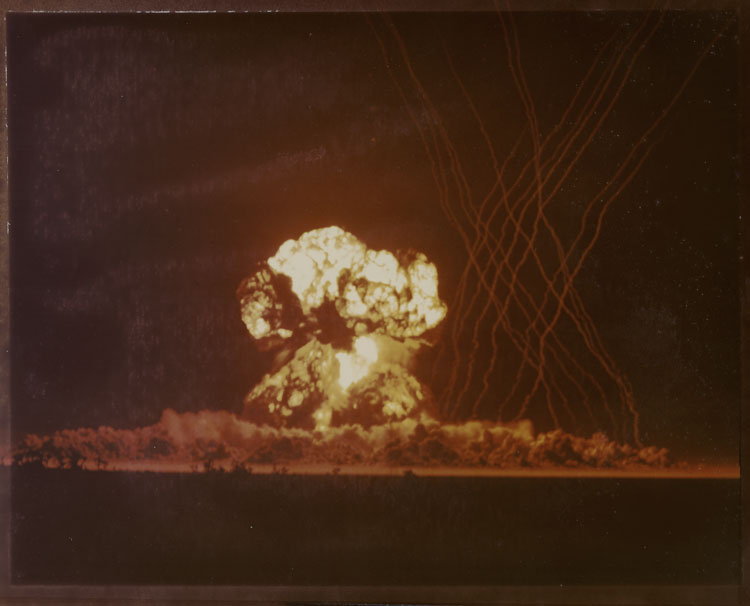
Hornet was a test of a nuclear warhead built to be fired up into one's own sky. It was a development shot for the W-30, the warhead of the Navy's Talos missile — a shipboard weapon meant to be launched into an incoming formation of enemy bombers and detonated among them, destroying the aircraft with a nuclear blast in the air. Fired from a 91-metre tower at the Nevada Test Site on 12 March 1955, Hornet produced 4 kilotonnes, well short of what the design could reach.
Hornet tested the boosted form of the warhead — a design in which a trace of fusion fuel sealed inside the core sharpens the fission explosion, the same principle of boosting that would become universal in later weapons. Its unboosted twin, fired three weeks earlier as shot Moth, had yielded two kilotonnes; the boost roughly doubled that, though both fell short of their predictions. The warhead the two shots were refining was among the smallest the United States had yet built.
The weapon embodied a grim premise of the early Cold War: that the way to stop a nuclear attack was to set off nuclear explosions of one's own, overhead, near one's own ships and coasts. More than a thousand Talos missiles were eventually built, many carrying versions of this warhead, though none was ever fired in anger. Hornet belonged to Operation Teapot, the 1955 Nevada series, and like the other tests of this warhead it did not keep its effects local: the fallout from the shots refining the Talos warhead was tracked across the continental United States and Canada, all the way to the Atlantic.