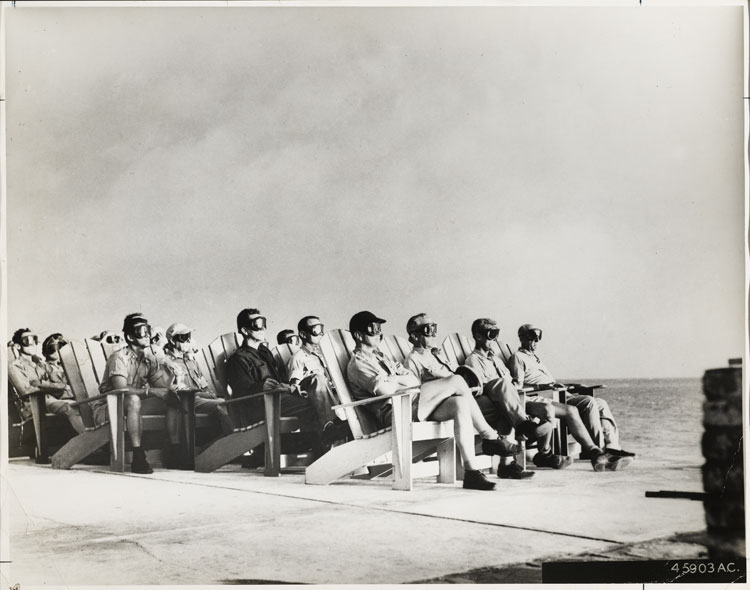
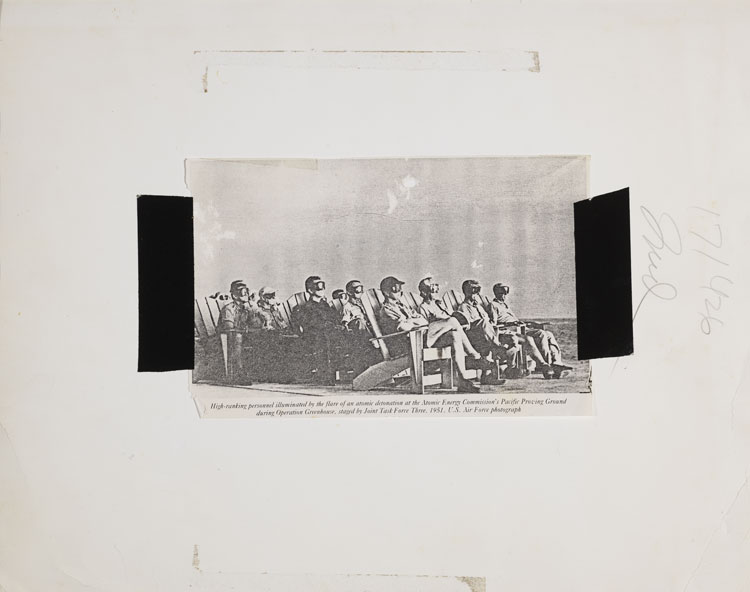
Dog is remembered less for its fireball than for its audience. For the detonation, a row of invited guests — senior officers and officials — was seated in wooden deck chairs on the patio of the Officer's Beach Club on Parry Island, issued dark goggles, and left to watch across the lagoon as the bomb lit them up. The photograph of that moment became one of the most reproduced images in the history of nuclear testing: the bomb as a show, staged for distinguished visitors.
The detonation they had come to see was, at the time, the largest the United States had ever set off. Dog was fired from a 91-metre tower on Runit Island at Enewetak Atoll on 8 April 1951, part of Operation Greenhouse — the series that first tested the principles leading to the hydrogen bomb. Dog itself was a more conventional shot: a proof test of the Mark 6, a new strategic bomb entering the American stockpile, refining the wartime Fat Man implosion design with more initiation points for a cleaner detonation. It yielded 81 kilotonnes, several times the Hiroshima bomb.
Enewetak was not empty ground. It was the home of the Marshallese people, who had been removed from the atoll so it could be used as a proving ground, and the Greenhouse shots spread fallout across inhabited islands of the atoll — part of a testing programme in the Marshall Islands whose radioactive legacy the Marshallese are still living with. The guests in the deck chairs watched from a safe and comfortable distance. The people whose islands these were did not have that choice.