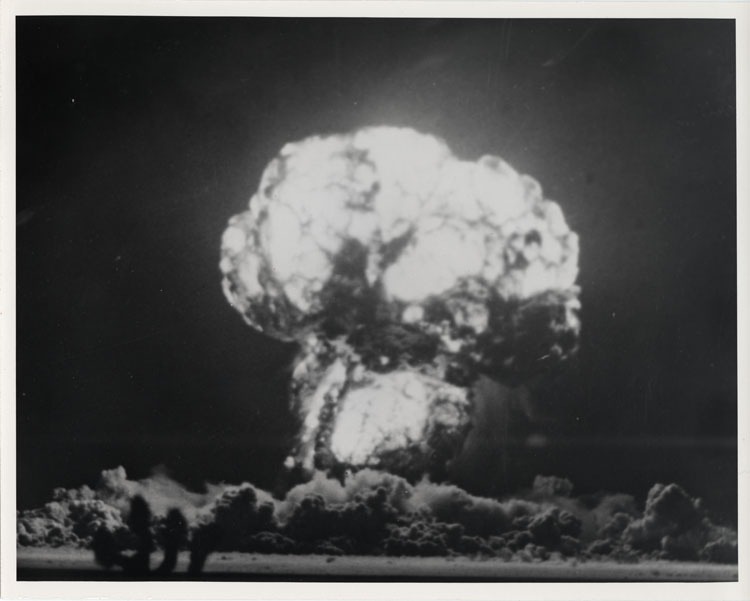
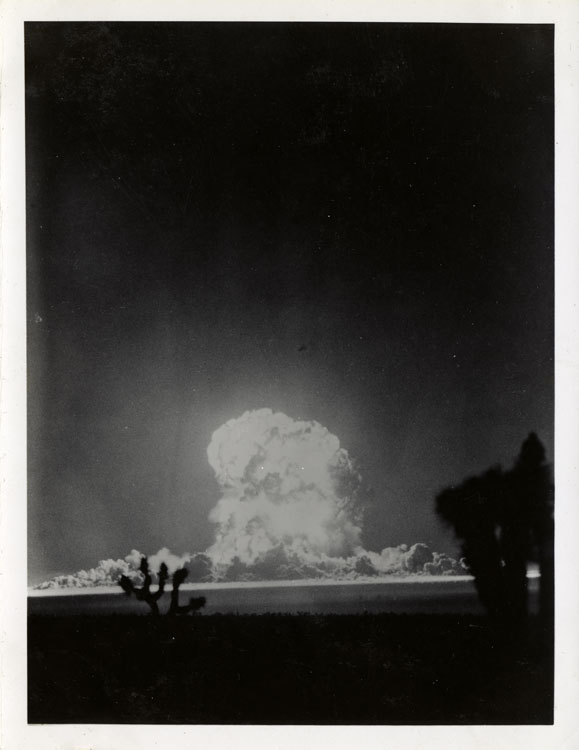
Apple-2 was the shot that destroyed a town built to be destroyed. On 5 May 1955, on a 152-metre tower at the Nevada Test Site, a 29-kilotonne device was fired over "Survival Town" — a full mock American community the government had constructed on the desert floor for the express purpose of blowing it apart. The town held five types of fully furnished houses, an electrical substation, radio towers, propane and natural-gas tanks, cars in the streets, stocked pantries, and about seventy mannequins posed as families eating and sleeping in their homes. It was the second and larger of two civil-defense spectacles staged in Nevada — the first, at shot Annie in 1953, had used only a pair of suburban houses — and it was run under the Federal Civil Defense Administration's "Operation Cue."
The purpose was persuasion as much as measurement. The FCDA wanted data on how ordinary houses, shelters, and materials stood up to a nuclear blast, but it also wanted images: the mannequin families, the furnished living rooms, the "before and after" of Mr. and Mrs. America's home, filmed and photographed and fed to a public it was trying to convince that nuclear war was survivable if only they prepared. Corporations supplied the furnishings and clothing for the free advertising, mannequins were displayed in department stores afterward, and the destruction was packaged as reassurance. Around six thousand spectators watched from a few kilometres away.
Apple-2 belonged to Operation Teapot, the 1955 Nevada series built around readying soldiers and civilians alike for the nuclear battlefield. Like the rest of the continental programme, its reach did not stop at the fences of the test site: the fallout from the Teapot shots drifted across the inhabited Southwest, adding to the radiation deposited on the very communities the exercise was meant to teach how to survive. Portions of Survival Town still stand in the desert today, a ruin left by an attack that was staged rather than suffered.