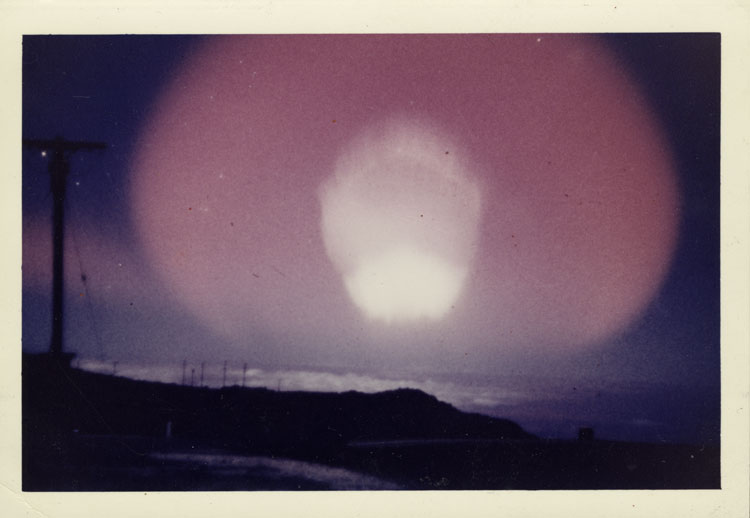
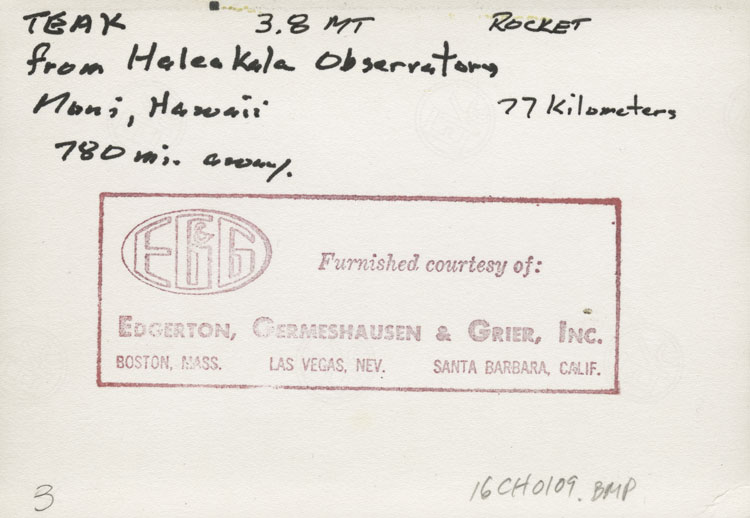
Shot Teak was a high-altitude nuclear test conducted on 1 August 1958 as part of Operation Hardtack I. A W-39 thermonuclear warhead with a total yield of 3.8 megatons — of which 1.9 megatons was fission yield — was launched from Johnston Island on a Redstone missile developed under Wernher von Braun, who witnessed the detonation from USS Boxer. The test was an Anti-Ballistic Missile effects test, designed to study whether a high-altitude nuclear detonation could disable incoming ballistic missiles and what effects it would produce on radar and communications systems. A guidance failure placed the burst directly above Johnston Island at 76.8 kilometres altitude rather than 9.7 kilometres to the south as planned, making the island the effective ground zero. The detonation injected fission debris into the ionosphere, cutting trans-Pacific high-frequency communications for up to nine hours. In Hawaii, 1,300 kilometres away, the fireball turned the night sky from yellow through orange to red; Honolulu police received over 1,000 calls from alarmed residents. The aurora effect was visible as far as Samoa, 3,200 kilometres to the south, where the Apia Observatory recorded the most brilliant manifestation of the Aurora Australis ever observed there. Along with Shot Orange, Teak was one of the two largest high-altitude nuclear explosions ever conducted. This photograph was taken from the Haleakalā Observatory on Maui — 1,256 kilometres from Johnston Island — and furnished by Edgerton, Germeshausen & Grier, Inc.