Shasta

Operation Plumbbob

August 18, 1957 · Nevada Test Site (NTS) · Tower · 17 kt

A nuclear device mounted at the top of a steel or wooden tower and exploded in the atmosphere.

↻ Show Verso↺ Show Recto

Unknown

Printed in 1961

Color print on fiber paper: A Kodak paper

8x10 in (20.3x25.4 cm)

↻ Show Verso↺ Show Recto

Lookout Mountain Laboratory, USAF

Printed in 1957

Silver gelatin print

8x10 in (20.3x25.4 cm)

Serial number, Stamp

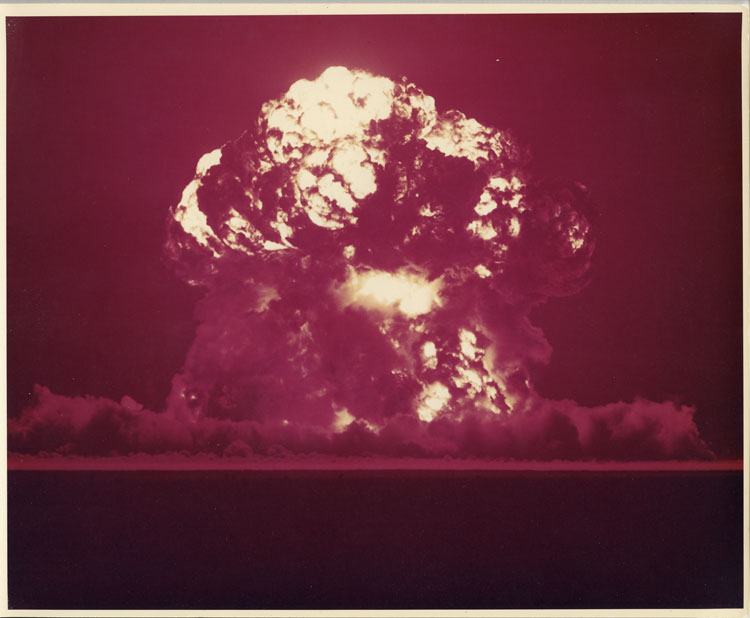
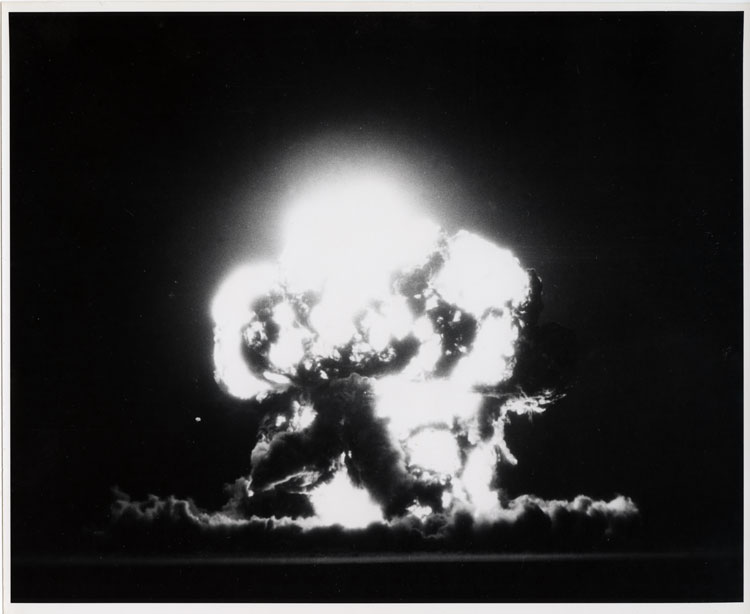
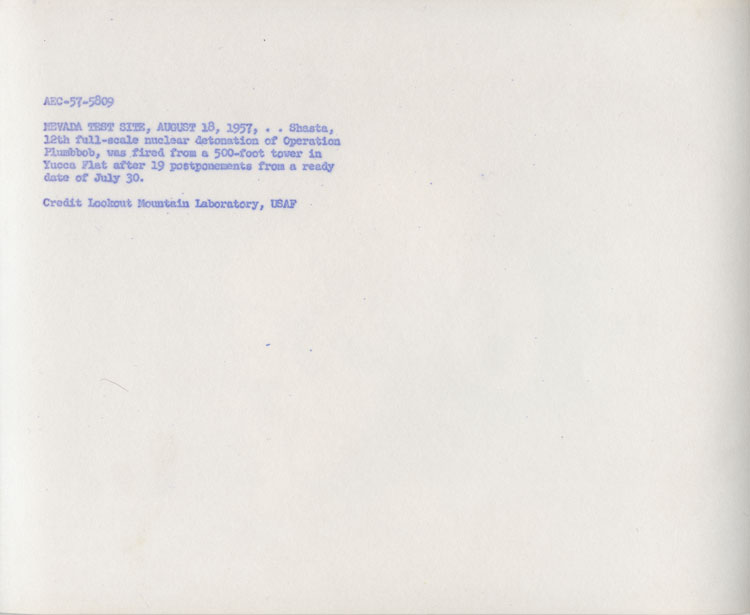
Partially clouded out by pre-dawn darkness, the Shasta cloud at its peak retains some of the glow of the fireball, following detonation from a 500-foot tower in Yucca Flat. The test was postponed 19 times after a ready date of July 30.
↻ Show Verso↺ Show Recto

Atomic Energy Commission (U.S.A.E.C.)

Printed in 1957

Silver gelatin print

8x10 in (20.3x25.4 cm)

Stamp

Partially clouded out by pre-dawn darkness, the Shasta cloud at its peak retains some of the glow of the fireball, following detonation from a 500-foot tower in Yucca Flat. The test was postponed 19 times after a ready date of July 30.
↻ Show Verso↺ Show Recto

Lookout Mountain Laboratory, USAF

Printed in 1957

Silver gelatin print

8x10 in (20.3x25.4 cm)

Serial number, Stamp

Shasta was a near-twin of the Diablo shot fired a month earlier, and another of Livermore's steps toward a deployable hydrogen bomb. Detonated from a 152-metre tower at the Nevada Test Site on 18 August 1957, it tested a two-stage thermonuclear design at reduced scale: a boosted "Swan" primary — the compact fission trigger the laboratory was refining across Operation Plumbbob — was fired inside a mockup of the larger weapon it was meant to ignite. Shasta differed from Diablo only in small details of its casing and core geometry; the two shots, taken together, worked out the variables of a design too intricate to settle in a single firing. Shasta belonged to Operation Plumbbob, the longest and largest test series ever conducted on the American mainland — twenty-nine shots across the summer and autumn of 1957, and the most heavily contaminating of all the continental series. It was one of many developmental firings behind the compact primaries that would arm the thermonuclear warheads then entering the American arsenal.