Mike

Operation Ivy

November 1, 1952 · Enewetak Atoll · Surface burst · 10400 kt

A nuclear device placed on or close to the earth's surface.

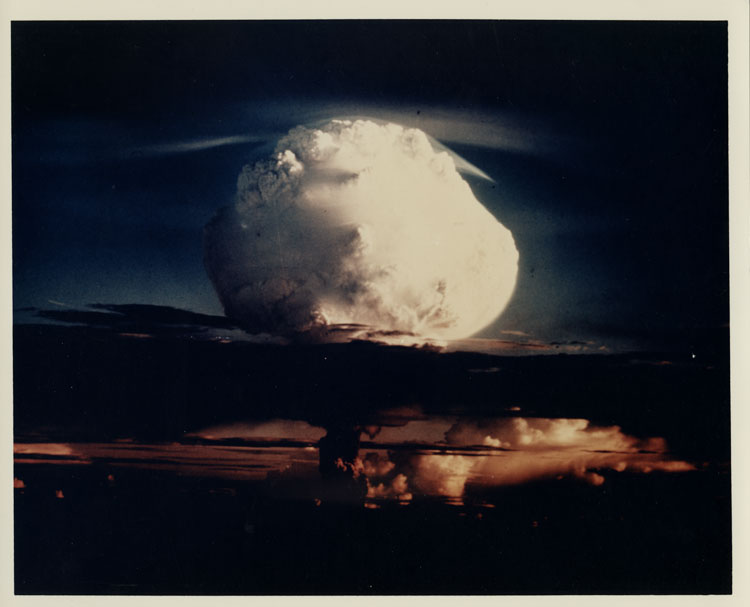
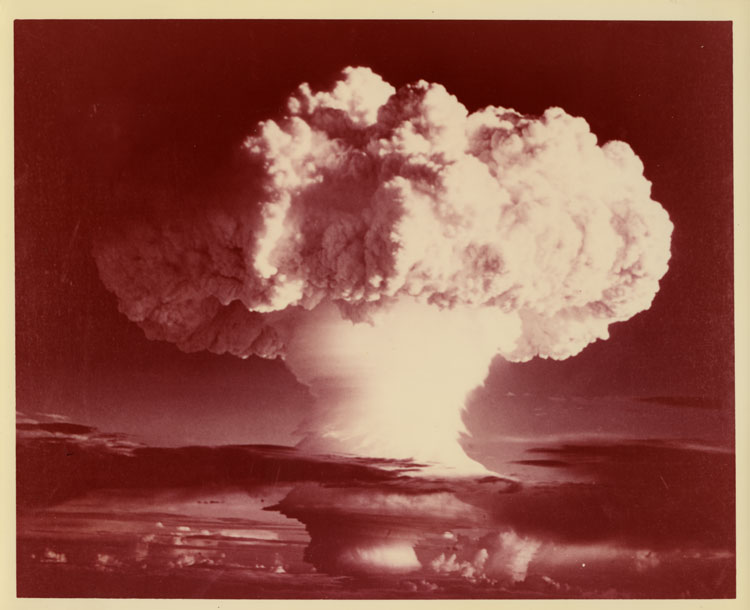
Color photograph of the mushroom cloud of Shot Mike, Operation Ivy, first thermonuclear device test based on Teller-Ulam staged radiation implosion, surface burst, Elugelab Island, Enewetak Atoll, 1 November 1952. Yield 10.4 megatons. No catalog number — verso blank.
↻ Show Verso↺ Show Recto

Unknown

Printed in 1950

Color print on fiber paper: Ektacolor

8x10 in (20.3x25.4 cm)

Color photograph of the mushroom cloud of Shot Mike, Operation Ivy, first thermonuclear device test based on Teller-Ulam staged radiation implosion, surface burst, Elugelab Island, Enewetak Atoll, 1 November 1952. Yield 10.4 megatons. No catalog number — verso blank.
↻ Show Verso↺ Show Recto

Unknown

Printed in 1952

Color print on fiber paper: Ektacolor

8x10 in (20.3x25.4 cm)

↻ Show Verso↺ Show Recto

US Air Force

Printed in 1954

Silver gelatin print

8x10 in (20.3x25.4 cm)

↻ Show Verso↺ Show Recto

US Air Force

Printed in 1954

Silver gelatin print

8x10 in (20.3x25.4 cm)

Stamp

Shot Mike was the first detonation of a true thermonuclear device, fired on 1 November 1952 as part of Operation Ivy at Elugelab Island, Enewetak Atoll in the Pacific. It was the first weapon built on the Teller-Ulam principle of staged radiation implosion — the design that would define all subsequent hydrogen bombs. The device was designed by the Panda Committee under J. Carson Mark at Los Alamos; Edward Teller declined to participate in its development. Codenamed Sausage, it used liquid deuterium as fusion fuel and weighed approximately 74 metric tonnes — too large and too dependent on cryogenic systems to be a deployable weapon. It was a proof of principle, not a bomb. The yield was 10.4 megatons, making it the fourth largest device ever tested by the United States. Elugelab Island was completely obliterated. The resulting crater measured approximately 1,900 metres across and 50 metres deep. Elevated radiation levels blanketed much of Enewetak Atoll in the aftermath.