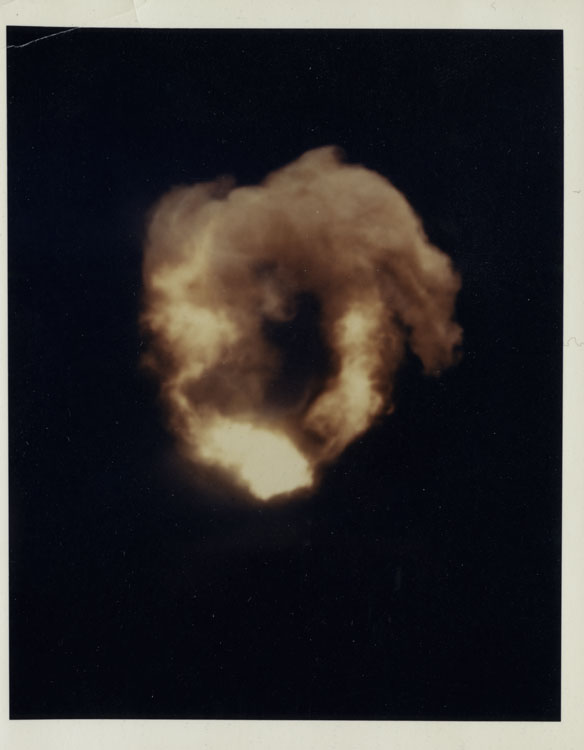
Shot John was the ninth nuclear detonation of Operation Plumbbob, fired on 19 July 1957 over Area 10 of the Nevada Test Site. An AIR-2A Genie nuclear air-to-air rocket was launched from an F-89J Scorpion interceptor and detonated at 5,639 metres altitude after travelling approximately 4,240 metres in 4.5 seconds, producing 1.7 kilotons. The W-25 warhead it carried was designed to destroy incoming Soviet bombers with a nuclear burst at close range, removing the need for a direct hit. To reassure military planners that troops on the ground would be safe beneath such a detonation, five Air Force officers and one civilian meteorologist were placed unprotected directly below the burst point at Indian Springs Air Force Base, approximately 3,000 metres beneath the explosion. They were photographed at the moment of detonation. All six survived without immediately observable effects, though the long-term health consequences of their exposure were never systematically studied. The exercise was as much a public relations event as a scientific one — a demonstration that nuclear weapons could be used over friendly territory without risk to those below.